

Applied Management Accounting
Course Overview
This comprehensive AAT Level 4 Professional Diploma course covers the complex techniques required for management accounting decision-making. From cost allocation to long-term planning, master the skills needed to drive business performance.
Course Modules
Activity Based Costing
Activity based costing, traditional absorption costing, cost drivers, cost pools, and the implications of allocating overheads by activities.
Start Module →Target Costing and Life Cycle Costing
Target costing, cost reduction, value analysis, life cycle costing, product life cycles, and the reliability of forecasts.
Start Module →Limiting Factor Analysis
Scarce resources, contribution, limiting factors, product ranking, optimal production plans, and the value of additional resource availability.
Start Module →Linear Programming
Linear programming assumptions, variables, objective functions, constraints, feasible regions, graphical solutions, simultaneous equations, and practical production choices.
Start Module →Short-Term Decision Making
Relevant costs and revenues, opportunity cost, make-or-buy choices, closure decisions, further processing, quotations, and qualitative factors.
Start Module →Calculating Forecasts
Time series, moving averages, seasonal variation, regression, index numbers, expected values, forecasting limitations, and sensitivity analysis.
Start Module →Introduction to Budgeting
Budget purposes, the budgeting cycle, responsibility accounting, participation, budgeting methods, uncertainty, planning assumptions, and budget revision.
Start Module →Budgeting Processes
Operating budgets, cost behaviour, production and resource budgets, inventory policies, losses, efficiency, cash forecasts, constraints, and revisions.
Start Module →Further Aspects of Budgeting
Budget constraints, responsibility centres, cost attribution, flexible budgets, variance interpretation, uncertainty, feedback, feedforward control, and coordinated planning.
Start Module →Standard Costing and Variances
Standard setting, standard cost cards, sales and cost variances, operating statements, variance causes, interdependence, significance, and control.
Start Module →Performance Measurement and Control
Financial ratios, working capital, productivity, service measures, quality costs, behavioural and ethical issues, and the balanced scorecard.
Start Module →Divisional Performance
Responsibility centres, controllable performance, return on investment, residual income, behavioural effects, transfer pricing methods, and divisional conflict.
Start Module →Long-Term Decision Making
Long-term decisions, payback, accounting rate of return, discounting, net present value, internal rate of return, and life cycle costing.
Start Module →Impact of Technology
Cloud accounting, artificial intelligence, machine learning, data analytics, big data, visualisation, technology benefits, risks, and adoption challenges.
Start Module →Companion Study Text
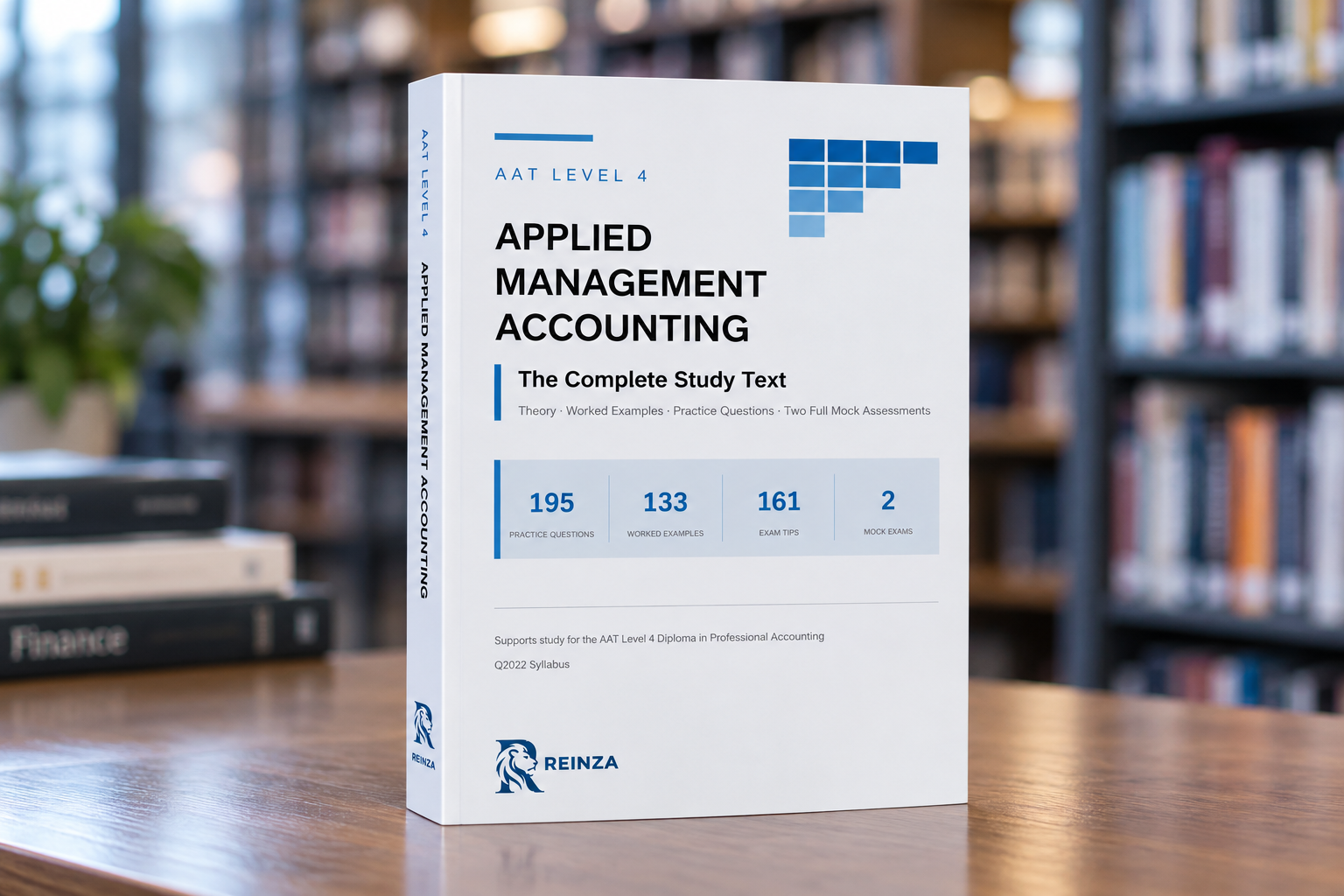
Applied Management Accounting
Complete Study Text · AAT Level 4 (Q2022)
Buy on Amazon