
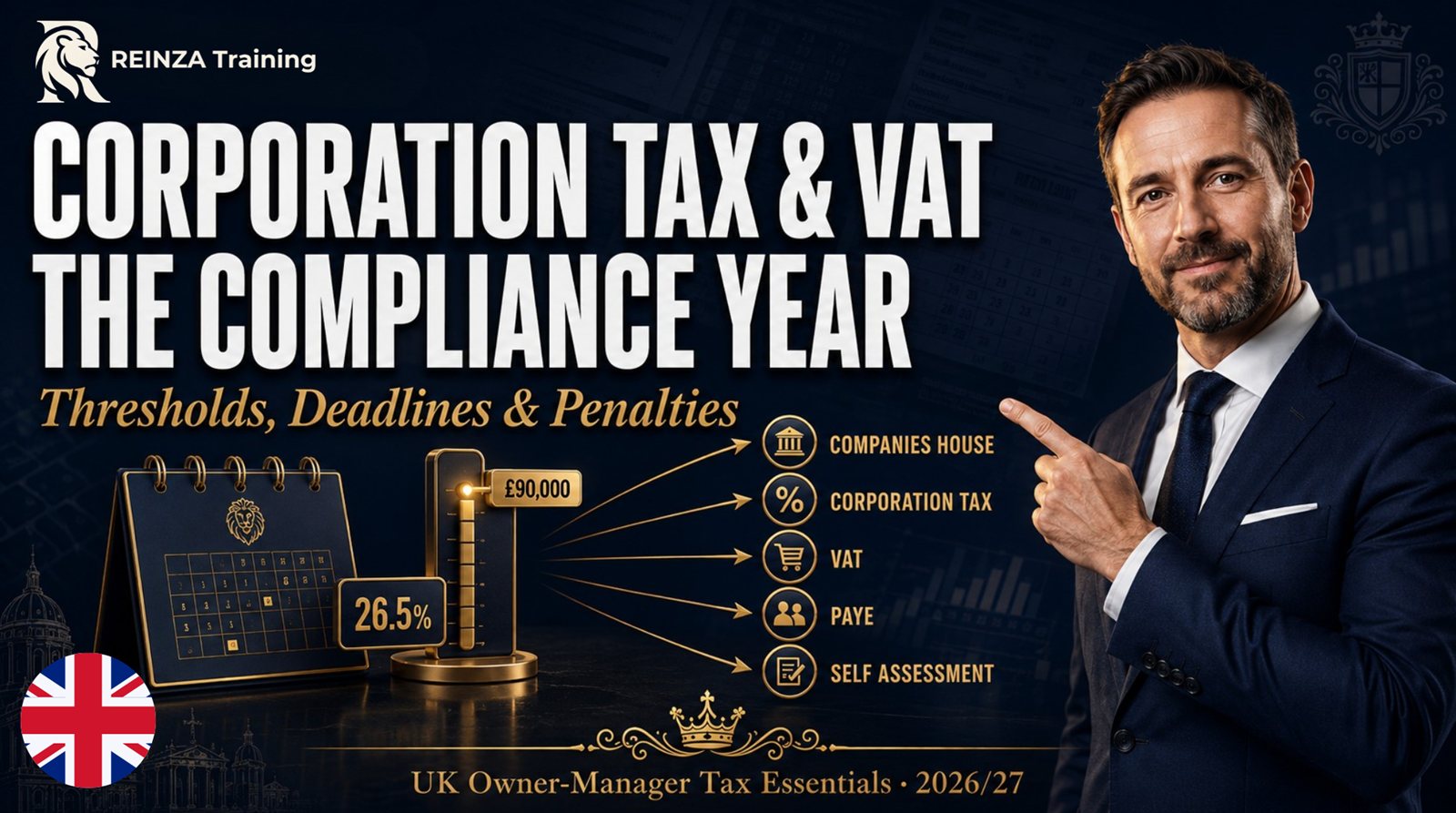
Module RT-103 · Tax Essentials for the Owner-Managed IT Company
Corporation Tax, VAT and the Compliance Cycle
Turning a profit figure into a tax liability, crossing the VAT threshold, and the five filing regimes that run at once
Course Overview
This module completes the programme. It builds a corporation tax liability from an accounting profit, using the adjustments the earlier modules established, then deals with the two things that arrive with growth: the VAT registration threshold and the compliance load that follows it. It closes with the five separate filing regimes an owner-managed company runs simultaneously, each with its own deadlines and its own penalty mechanism.
Course Modules
Click on each module to expand the content.
A company does not pay tax on the profit shown in its accounts. This section builds the liability step by step, treats the familiar four-step model as the simplification it is, and explains why the rate is not a single number. It then covers two refinements that catch owner-managed companies out — augmented profits, and the way the rate limits are shared between associated companies and shrink accordingly — before dealing with payment and filing dates, and why a new company usually files two returns for its first period.
Corporation tax is charged on the profit of an accounting period, so which period a transaction falls into can change which year it is taxed in and sometimes the rate it bears. This section identifies where genuine timing choices exist and where they do not, and draws out the difference between two words that are routinely treated as the same: incurred and paid.
For an owner-managed company an employer pension contribution is often the most efficient way of moving value out of the company, and in many cases more efficient than either salary or dividends. It earns its own section because the amounts can be large, because the rules sit in two separate places that are easily confused, and because the trade-off attached is a real one. This section separates the two rule sets, covers the annual allowance and the two ways it can be reduced, and states the trade-off properly rather than as a slogan.
The VAT question arrives with growth whether or not it is wanted, and registering late carries a real cost that falls on the company rather than on its customers. This section covers the two separate tests a business has to watch, what counts towards taxable turnover, the point that specifically catches IT companies that resell hardware, what "effective date" means, what late registration costs, the exception for a one-off spike, and why registering before you have to is sometimes the right answer.
Registration changes three things at once, and one practical sequence is easy to get wrong. This section covers what can and cannot be reclaimed as input tax, how far back pre-registration input tax reaches, the three small business schemes and their limits, the test that decides which flat rate applies, how the tax point determines which return a supply falls into, and the pricing decision that should be made before registering rather than after.
Making Tax Digital affects fewer taxes than most coverage suggests, and the coverage is confusing because the programme's scope has changed several times. This section states plainly which obligations it actually reaches and which it does not, then covers a second question most coverage misses entirely: the filing obligations that have become software-only for reasons unconnected with Making Tax Digital.
An owner-managed company does not have one deadline a year. Once VAT-registered it runs five separate streams of obligations simultaneously — Companies House, corporation tax, VAT, PAYE, and the director's own self-assessment — each with its own deadlines and its own penalty mechanism. This section takes each in turn, then shows the cycle whole.
The programme's three modules, assembled into a single company year: from accounting profit to tax liability, across the VAT threshold, and into the compliance cycle. It closes with the five points worth carrying away, and a note on the programme as a whole.
Course Resources
Download Course Materials
Get the complete course pack for this module.
Download Course Materials
A printable reference for the five filing regimes and their deadlines.
Video Tutorial
Watch our detailed walkthrough.
Need Professional Help?
Our team handles corporation tax, VAT registration and the filing calendar for owner-managed companies.
- ✓ Corporation tax computation and CT600
- ✓ VAT registration and returns
- ✓ Companies House filings
- ✓ Payroll and RTI reporting
- ✓ Deadline monitoring
In This Programme
- RT-101 Company Money and Personal Money
- RT-102 Allowable Expenses and Capital Allowances
-
RT-103 Corporation Tax, VAT and the Compliance Cycle Current